Brine Strength, Mash Temperature, and Extraction: What Soy Sauce Breweries Monitor Before Changing Inputs
In soy sauce brewing, extraction is not controlled by one lever. Brine strength, moromi temperature, koji condition, mash viscosity, fermentation age, mixing behavior, and enzyme dosage discipline all influence how well soluble flavor precursors move from the mash into the liquid phase.
For fermentation managers, the practical question is rarely, “Can we release more nitrogen?” It is usually more specific: can we improve extractability without disturbing aroma development, salt balance, filtration behavior, or traditional product character?
Moromi Pulse supplies enzyme solutions for soy sauce fermentation with that operating reality in mind. Before changing inputs, we recommend looking closely at the environment where extraction actually happens.
Why brine strength changes more than salt perception
Brine concentration sets the microbial and biochemical environment of the moromi. It also affects water availability, protein swelling, soluble solids movement, and the way suspended material behaves during aging and pressing.
When brine strength shifts, breweries may see changes in:
- Nitrogen release profile from soybean and wheat substrates
- Peptide and amino acid availability for umami depth
- Mash viscosity and solids suspension during tank circulation or mixing
- Fermentation selectivity, especially in relation to salt-tolerant flora
- Pressing and filtration behavior downstream
- Batch-to-batch flavor continuity when raw material quality varies
A stronger brine environment may protect traditional fermentation stability, but it can also slow extraction kinetics. A weaker brine may support faster solubilization, but it can place more pressure on microbial control, aroma balance, and product specification.
The best operating window is therefore not only a salt target. It is a balance between heritage quality, process security, and extract recovery.
Temperature is an extraction variable, not just a fermentation variable
Mash temperature influences the rate of biochemical conversion, diffusion, microbial metabolism, and physical flow. In soy sauce breweries, the temperature profile across aging is often shaped by season, tank geometry, climate control limits, and production scheduling.
Before modifying enzyme strategy, it is worth reviewing whether temperature variation is creating extraction inconsistency.
Key questions to ask on the plant floor
- Are warmer tanks showing faster early nitrogen release but different aroma development?
- Are cooler tanks producing slower extraction and longer hold times?
- Does mash viscosity change noticeably between seasonal batches?
- Are operators compensating with additional mixing, longer aging, or altered pressing schedules?
- Do filtration issues appear after temperature swings or raw material changes?
Temperature does not act alone. The same enzyme dosage can behave differently if the moromi environment changes in salinity, solids distribution, or thermal history.
The extraction problem often appears downstream
A batch may look acceptable during fermentation but reveal its extraction limits later: slower pressing, cloudy liquor, higher sediment load, inconsistent color development, or a flavor profile that lacks the expected rounded umami.
These symptoms can originate upstream in the mash environment.
Common operating signals
- High mash resistance during circulation or transfer
- Uneven soluble nitrogen release between tanks
- Longer settling time before clarification
- Filter loading earlier than expected
- Press cake retaining valuable extract
- Variable first-run liquor intensity
- Aroma deviation when extraction is accelerated too aggressively
The goal is not simply to break down more substrate. The goal is controlled release: soluble flavor material entering the liquid phase at a pace the brewery can manage.
Where enzyme inputs fit into the decision
As an enzyme supplier for soy sauce fermentation, Moromi Pulse focuses on controlled process support rather than one-size-fits-all intervention. Enzyme inputs may support protein breakdown, starch conversion, viscosity management, or extractability depending on the brewery’s substrate, koji quality, brine system, and fermentation schedule.
However, enzyme selection should be made only after the process environment is understood.
Before changing enzyme dosage or blend, document:
- Brine strength range across recent batches
- Moromi temperature profile by tank, season, and production zone
- Koji quality indicators relevant to substrate accessibility
- Mixing or circulation frequency and observed dead zones
- Viscosity and handling behavior during early, middle, and late fermentation
- Nitrogen release trend over the batch, not only the final value
- Clarification and filtration performance after pressing
- Flavor approval notes from sensory and QC teams
This creates a clearer baseline. It also prevents a common mistake: increasing enzyme intensity to solve a physical process issue caused by temperature distribution, brine variation, or solids handling.
Brine, temperature, and viscosity are linked
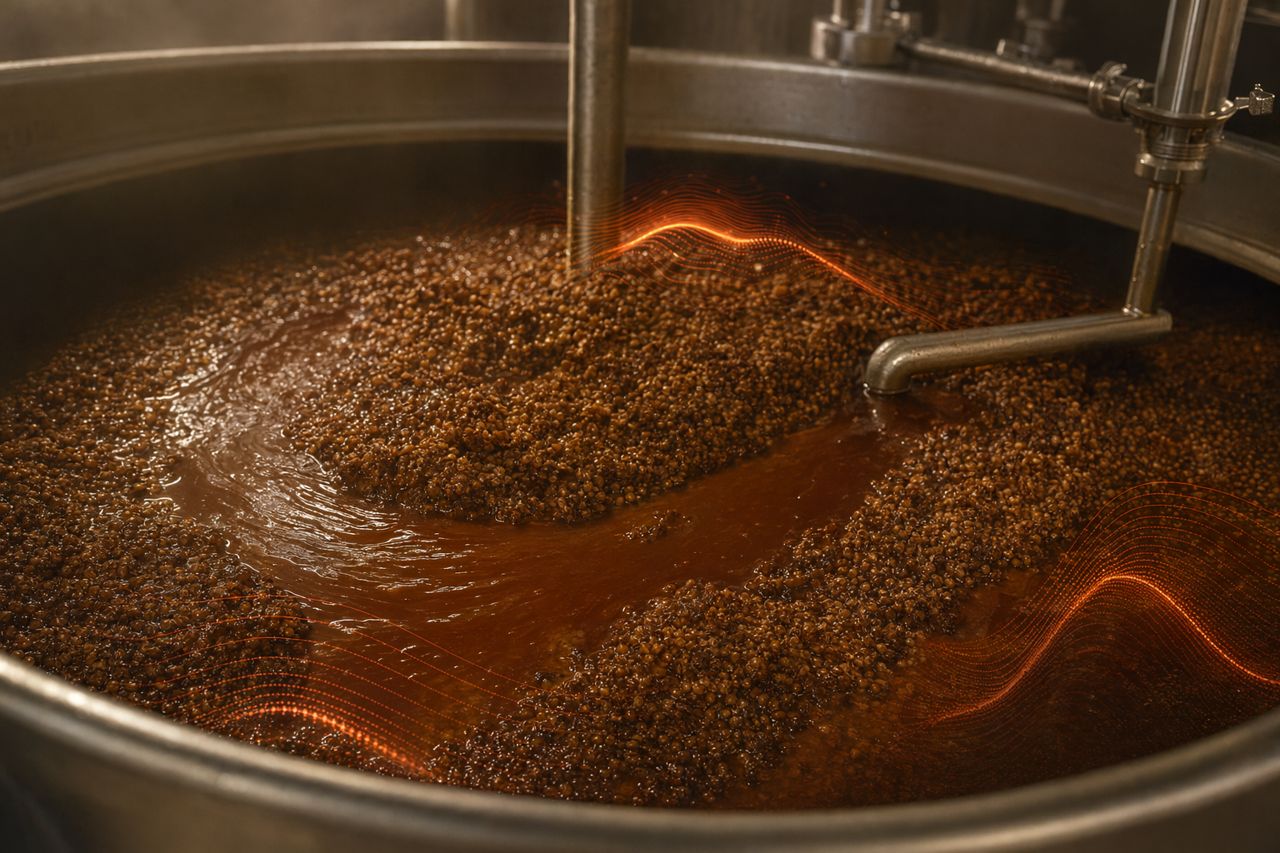
Moromi is a dense fermentation system. Small changes in solids hydration, protein breakdown, and microbial activity can affect how the mash folds, releases liquid, and separates later.
When viscosity remains high, extract may be physically trapped even when biochemical conversion is progressing. When viscosity falls too sharply, the brewery may face different concerns: faster sediment movement, changed mouthfeel, altered clarification load, or flavor imbalance.
A disciplined enzyme program should support the brewery’s preferred fermentation character while improving process predictability.
Practical monitoring framework for breweries
For breweries evaluating extraction improvement, Moromi Pulse recommends separating observations into three operating layers.
1. Fermentation environment
Track the conditions that shape enzyme and microbial behavior:
- Brine strength consistency
- Temperature by tank zone and season
- pH trend and fermentation age
- Raw material hydration and grind condition
- Koji performance and storage time before mashing
2. Mash behavior
Observe what operators can see and feel in the process:
- Folding behavior during mixing
- Resistance during transfer
- Surface drying or localized compaction
- Solids suspension uniformity
- Aroma development at different tank depths
3. Downstream separation
Measure the cost of extraction quality after fermentation:
- Pressing time
- Liquor clarity
- Sediment load
- Filtration pressure trend
- Filter change frequency
- Yield from comparable press cycles
This framework helps identify whether the brewery needs an enzyme adjustment, a process-control correction, or both.
Avoiding overcorrection
Extraction improvements can create secondary effects. More soluble material may increase umami depth, but it can also alter color formation, viscosity, sediment behavior, or filtration demand. Faster nitrogen release may support shorter production cycles, but only if aroma development and product identity remain within the brewery’s standards.
For traditional soy sauce makers, the most valuable enzyme program is not the most aggressive one. It is the one that respects the house style while reducing avoidable variation.
How Moromi Pulse supports controlled extraction work
Moromi Pulse works with soy sauce breweries that need practical enzyme support for fermentation performance, extract recovery, viscosity behavior, and batch consistency. We help technical teams evaluate the interaction between brine, temperature, mash condition, and downstream clarification before recommending an input strategy.
Our approach is plant-floor oriented:
- Match enzyme function to brewery objective
- Protect sensory quality and traditional product expectations
- Support consistent nitrogen release and extractability
- Improve mash handling without creating downstream instability
- Build dosage discipline around the brewery’s real process window
- Help compare trial batches against current production baselines
Request a quote
If your brewery is reviewing extraction, fermentation time, mash viscosity, or clarification performance, Moromi Pulse can help evaluate the right enzyme direction for your soy sauce process.
Request a quote through the on-site form
Share your product type, batch size, brine range, fermentation schedule, and the operating issue you want to improve. We will respond with a practical recommendation for next-step discussion.